I began my career in the nonprofit sector as the administrative assistant to the membership and development department at the Fort Wayne Museum of Art. My predecessor in this role had figured out how to set up the donor database and the required hardware to make it run, so she became the “accidental techie” for the organization, and I inherited this role when I was hired.
When I started the museum job in 1997, I didn’t know what an “accidental techie” was – I don’t think the phrase was even part of the lexicon back then. Looking back, however, I can see the phenomenon I was experiencing was happening in organizations all over the country.
The nonprofit sector has notoriously been slow to change and adoption of technology is no different. This is due in no small part to the lack of funding for operating costs to run our organizations. In the late 90s, we were not only up against the “overhead myth,” but personal computers were still relatively new and not a regular fixture on peoples’ desks at home or even at work!
When I started the museum job in 1997, I didn’t know what an “accidental techie” was – I don’t think the phrase was even part of the lexicon back then. Looking back, however, I can see the phenomenon I was experiencing was happening in organizations all over the country.
In my new role at the museum, I attended training on Novell Networks within my first few weeks so I could confidently manage the server and computers. At the time, all of our applications were DOS-based. I helped secure two technology grants that upgraded many of our systems to Windows-based software.
I managed and maintained the organization’s computers, printers, and peripherals, provided user support for multiple software applications, and served as liaison to our technology support company. I also helped design the museum’s first website and selected its first digital camera, which stored photos on 3.5-inch floppy disks.
In 2002, after advocating for myself, my position was changed to membership and technology manager. It took five years of managing the technology, while also doing development work, to have my title reflect all my responsibilities.
As I continued to progress in my role, I found the technology aspects of my job interesting and challenging, so I decided to further my education. I went back to school to get a degree in computer science to go with my first degree in fine arts.
In the fall of 2003, I attended an event in Indianapolis called The Nonprofit Technology Summit hosted by the Indiana affiliate of NPower, a national network of nonprofits dedicated to “putting technology know-how in the hands of nonprofits.”
After spending years feeling alone working at a nonprofit and having to figure out how to use technology, largely on my own, here was a conference full of people in the same boat.
The tagline for the Summit was “helping nonprofits achieve their mission through the creative and innovative use of technology.” After spending years feeling alone working at a nonprofit and having to figure out how to use technology, largely on my own, here was a conference full of people in the same boat. Attending the event felt like coming home – I had found my people – and I never forgot that feeling.
In January 2004, I left the museum to be the development coordinator at the social service nonprofit where I still am today – Brightpoint. While I didn’t end up taking a tech job, my experience with technology helped me land my new role. My position had just been created to start a development program. My first order of business was to set up the donor database, software that had been purchased, but was literally still in the box.
In February 2021, I got an email from Amy Sample Ward, at NTEN. The subject of the email was “Being in community has gotten difficult and a whole lot more important.” This struck a chord with me. During the Covid-19 pandemic, I was reminded just how important it is “to be in community with people who ground me, support me, and really see me” – as Amy said in the email.
That month, I signed up to be a member of NTEN and registered to attend the Nonprofit Technology Conference. It was phenomenal. I found people who understood me, ideas that challenged me, and a community of like-minded individuals wanting to do good in the world. It was reminiscent of the way I felt at the Technology Summit in 2003.
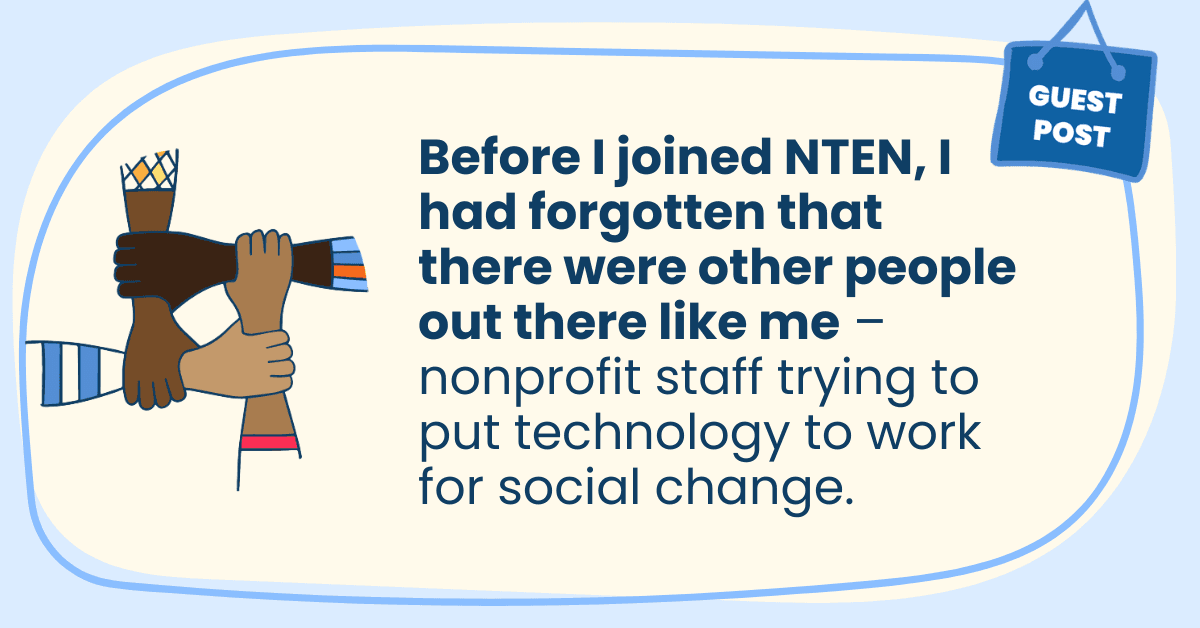
Before I joined NTEN, I had forgotten that there were other people out there like me – nonprofit professionals trying to put technology to work for social change – many of us doing it while filling other roles at our organizations. At 26NTC this year, I left with a renewed sense of the importance of community.
When I tell someone who is unfamiliar with NTEN about it, they often look confused. Why am I involved with a technology organization when I have a development job?
I signed up to be a member of NTEN and registered to attend the Nonprofit Technology Conference. It was phenomenal. I found people who understood me, ideas that challenged me, and a community of like-minded individuals wanting to do good in the world.
Unlike the world I started my career in, computers are now part of all of our jobs. And the unique challenges of navigating technology in our sector are something that make NTEN a community that anyone working at a nonprofit can benefit from.
Because the reality is: we all work in technology now. And it’s challenging, but you don’t have to go it alone.
Jennie Renner
she/her/hers
Development /Communications Manager, Brightpoint
I’m a creative who found my way into tech the nonprofit way – by accident. That experience sparked something, and I went back to school to earn an AAS in computer information systems to complement my BA in fine arts.
Today I lead fundraising, communications, and marketing at Brightpoint, bringing together storytelling, strategy, and technology to move our mission forward.
I also serve as co-organizer for NTEN’s Women in Nonprofit Tech affinity group, where I help cultivate a space for connection, encouragement, and authentic conversations about what it means to do this work.
When I’m not working, you’ll find me writing, reading, making art, listening to music, or getting lost in meaningful conversations.
CliftonStrengths is one of my favorite lenses for understanding people and potential. I lead with Ideation, Input, Individualization, Intellection, and Maximizer– strengths that show up in how I create, connect, and continuously learn.
