One year after the cancellation of the Digital Equity Act, many organizations doing digital inclusion work are still trying to navigate what comes next. We spoke to our Digital Inclusion fellows, who work in digital equity programs across the country, to understand how they are managing their work amidst this funding and political climate.
The loss of federal funding disrupted programs and expansion plans, but fellows in NTEN’s Digital Inclusion Fellowship describe something broader, too: uncertainty that touches nearly every part of the work, even beyond digital inclusion programs. Community organizations are losing staff, funding, and partners. Libraries are defending their existence. Some organizations are changing language to avoid political scrutiny. In immigrant communities, people are increasingly hesitant to attend trainings or gather in public. At the same time, the need for digital inclusion work has not changed.
Passed with bipartisan support, the legislation recognized internet access and digital literacy as essential infrastructure for participation in modern civic life.
Also read: NTEN statement supporting the Digital Equity Act
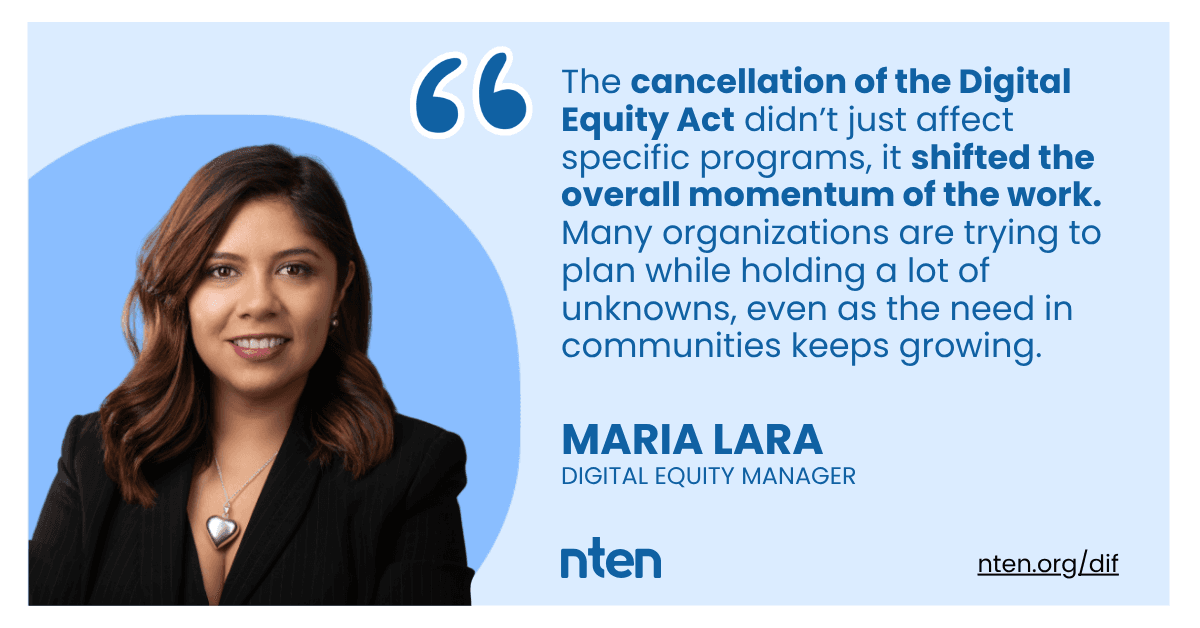
“Over the past year, the digital equity field has been moving through a lot of uncertainty,” said Maria Lara, Digital Equity Manager at NTEN. “The cancellation of the Digital Equity Act didn’t just affect specific programs; it shifted the overall momentum of the work. Many organizations are trying to plan while holding a lot of unknowns, even as the need in communities keeps growing.”
For the past decade, NTEN’s Digital Inclusion Fellowship has supported nonprofit and community leaders building digital literacy programs rooted in the realities of their local communities. Fellows work in libraries, schools, housing organizations, workforce programs, immigrant-serving organizations, and community centers across the United States. Their projects range from basic computer skills training to device access, accessibility support, digital navigation, and community-based technology education.
The Digital Equity Act had created new possibilities for this work. Passed with bipartisan support, the legislation recognized internet access and digital literacy as essential infrastructure for participation in modern civic life. One year since the Act was scrapped, we must ensure that Congress does not heed the President’s budget request to eliminate the Digital Equity Act funds from the FY2027 budget. Learn more and see how you can get involved in the DEA Month of Action by the National Digital Inclusion Alliance.
Our current cohort of Digital Inclusion Fellows describes what it looks like to continue this work while funding disappears and political pressure intensifies.
Funding instability is reshaping day-to-day work
For many fellows, the most immediate effect of the Digital Equity Act’s cancellation was the disappearance of funding that organizations had already begun planning around.
One fellow working in a library described how quickly priorities shifted:
“Progress was slowed for a couple of months because we all had to pause from doing the real work to make sure the state library would still exist months from now – updating documents with the ‘correct’ phrasing. We still don't know the fate of the next fiscal year. On the funding side, the digital skill grants I had applied for no longer exist. $1.2 billion in nationwide funding was gone overnight. Some partner organizations had all or most of their funding pulled, further slowing progress. Book bans and reports of death threats to librarians across the state are a scary little backdrop as we all try to connect our communities with the resources they need to survive and thrive in a changing world.”
We must ensure that Congress does not heed the President’s budget request to eliminate the Digital Equity Act funds from the FY2027 budget.
Others described smaller but equally disruptive changes inside their organizations.
“One of our team members was laid off in June due to funding losses, and we have been experiencing ongoing staffing challenges since then.”
“We are not certain of the funding we have in the future for me to expand and put funds towards this project. Although it is needed, extensions for Microsoft Accessibility would need to be purchased, and funds cannot be allocated to this at this time. I had more plans to further this project, but they may have to wait for approval.”
Several fellows also described the ripple effects of funding losses across local nonprofit networks.
“Many nonprofits that I collaborate with have lost grant-funded staff. It has made it more difficult to get a hold of people and contacts.”
“Our funding has not been affected, but I lost a major partner that was utilized for the project.”
As we’ve said before, digital inclusion work is not abstract policy work — it affects whether people can apply for jobs, access healthcare, communicate with schools, stay connected to loved ones, and participate fully in their communities. Fellows’ responses make clear how difficult it becomes to sustain that work when organizations are operating with reduced staff, uncertain budgets, and fewer community partners.
Fear and political pressure are changing how communities participate
Several fellows working with immigrant communities described a growing fear of attending in-person programming.
As these fellows shared:
“The Latin community that I work with is afraid to leave their homes, which affects us a lot since my project is meant to have groups of 10 people. There are times when I only have 4 or 5 participants.”
“While our communities trust our organization, there is still a fear we see from folks not wanting to be outside as often, impacting attendance at our programming.”
Book bans and reports of death threats to librarians across the state are a scary little backdrop as we all try to connect our communities with the resources they need to survive and thrive in a changing world.”
Another fellow described seeing both challenges and opportunities in their work right now:
“The current funding and political climate have presented both challenges and opportunities for digital equity work in our community. As a Digital Inclusion Fellow, I’ve seen how fluctuating funding streams and shifting political priorities can make it difficult to sustain long-term digital literacy programs, especially with limited resources. However, there are many opportunities, especially right now, to connect with families and our community. It has also been hard to get families to show up in person due to the immigration climate.”
For some fellows, those concerns have become part of the daily reality of teaching and outreach.
“The current political climate has affected my digital equity work heavily. I remember one night when I was teaching late, and we had an ICE-spotting three blocks away from where we teach. Even as a birthright citizen, I'm concerned about traveling to teach.”
Fluctuating funding streams and shifting political priorities can make it difficult to sustain long-term digital literacy programs, especially with limited resources.
Others described pressure inside their organizations to change language or avoid terminology that might draw political scrutiny.
“We had to rebrand our program to keep away from ‘buzzwords’ that would jeopardize other funding needed to keep our organization afloat. We are no longer able to serve undocumented community members in any capacity, which goes against the very nature of digital equity work.”
That fellow also described how conversations about future collaboration stalled after expected state funding disappeared.
“Without that funding, those conversations halted as no one had the extra funds for digital equity. We are working on creative solutions and creating new partnerships to continue closing the digital divide for everyone in our communities.”
The responses reflect a difficult tension. Organizations are continuing to respond to community needs while also navigating growing pressure around who can safely participate, what programs can be publicly supported, and what language feels safe to use.
Also read: The Digital Equity Act one year later – NDIA
The work continues because the need has not gone away
Despite the strain evident in many responses, fellows also described continuing to adapt their programs and partnerships because the need for digital inclusion work remains immediate.
One fellow explained:
“Despite these challenges, our team continues to collaborate with community partners, adapt our curriculum, and seek alternative funding sources to keep workshops running. The cuts have underscored the urgent need for long-term, reliable investment in digital inclusion – not just as a program, but as a fundamental part of community development and equity.”
We had to rebrand our program to keep away from ‘buzzwords’ that would jeopardize other funding needed to keep our organization afloat. We are no longer able to serve undocumented community members in any capacity, which goes against the very nature of digital equity work.
In her role managing the Digital Inclusion Fellowship at NTEN, Lara hears directly from fellows across the country about what sustaining this work looks like right now.
“In my day-to-day, I hear from fellows across the country, and what they share stays with me,” Lara said. “Their stories, their creativity, the way they show up for their communities with so much care. There is a lot of love and passion in this work, and you can feel it in how they talk about the people they serve and their projects.”
Over the past decade, fellows in NTEN’s Digital Inclusion Fellowship have worked across 28 regions, partnered with more than 125 organizations, and reached nearly 59,000 participants.
Those numbers reflect work happening in libraries, classrooms, housing organizations, and community centers across the country. They also reflect the reality that digital inclusion is ongoing community infrastructure, not a short-term initiative.
“The need is still there, and this work is far from done,” Lara said. “Digital inclusion is not something temporary. It requires continuing commitment, trust, and investment in the communities we serve.”
One year after the cancellation of the Digital Equity Act, practitioners are still finding ways to continue serving their communities. But the fellows’ responses also make clear that community commitment alone cannot replace stable investment, staffing, and long-term support.
Admin NTEN
NTEN
We can change the world when we change our approach to technology. NTEN helps you do your job better, so you can make the world a better place. Join our community, and you can drive social change by putting technology to use for your mission.
